
2016 Fashion Trends Are Back in 2026: Data & Nostalgia Trend
.webp)
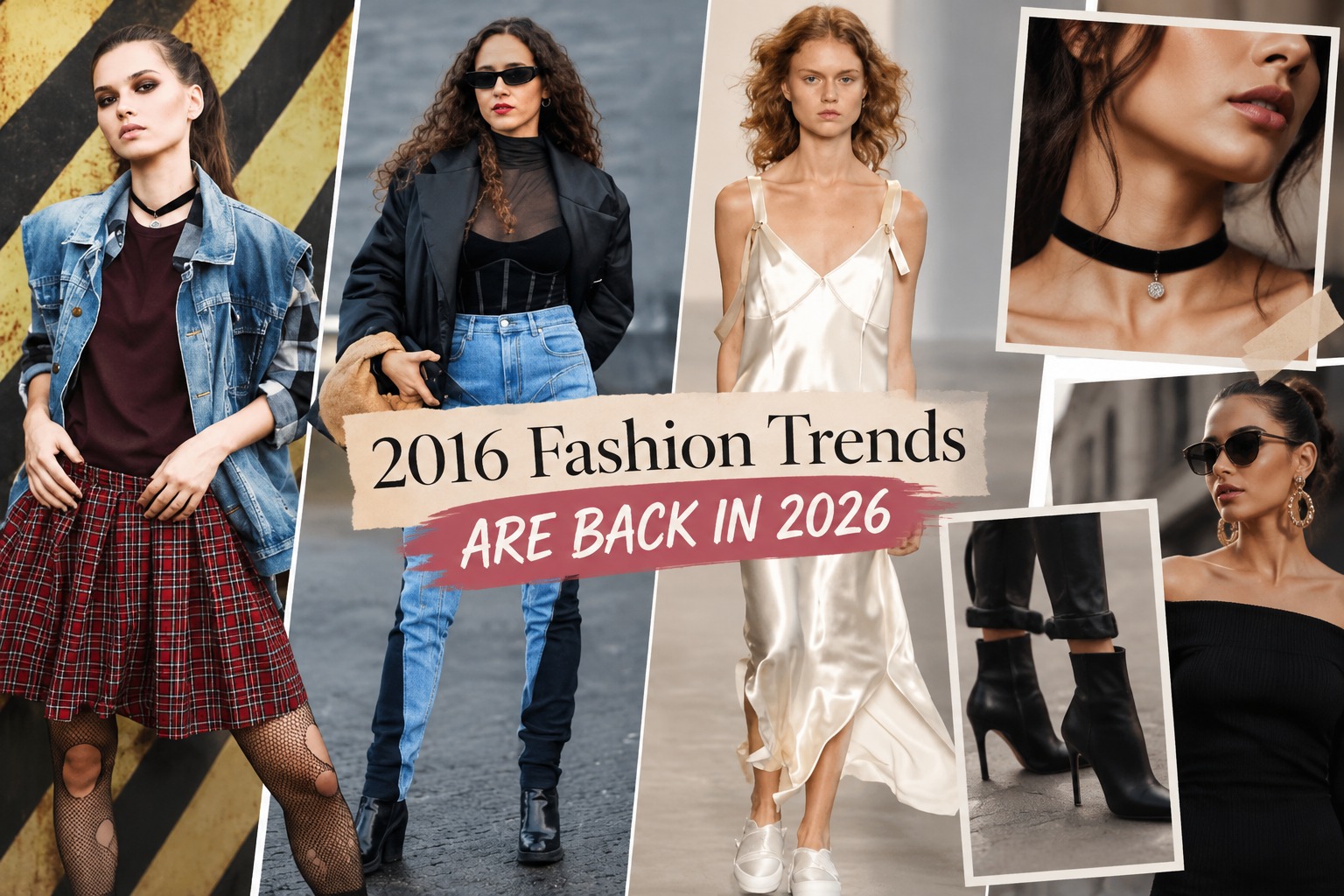
2016 fashion trends are making a comeback in 2026, but not every viral revival is becoming a real retail trend. Skinny jeans are back on runways, chokers are reappearing in street style, and slip dresses are showing up under blazers instead of alone at a party. Trendalytics tracked this shift closely because it's not just fashion cycling naturally.
This revival is tied to a specific, dated social media moment: the "2026 is the new 2016" trend, which started in December 2025 and spread fast across TikTok. That distinction matters. A trend born from a viral cultural moment behaves differently than one that builds slowly through runway influence, and knowing which is which changes how a brand should actually respond to it.
Here's the quick version before the full breakdown:
- Skinny Jeans: were an everyday staple in 2016, now showing a strong retail comeback
- Bomber Jackets: were a streetwear essential in 2016, now seeing renewed attention rather than starting from zero
- Chokers: were a statement accessory in 2016, now mostly social-driven with less retail data behind it
- Slip Dresses: were party/nightwear in 2016, now reworked as a modern layering piece
- Statement Earrings: was a bold accessory in 2016, now in an early revival stage
The Social Media Moment Behind the Revival
The phrase "2026 is the new 2016" first appeared online in late December 2025, tied to a broader social media movement nicknamed the Great Meme Reset. A TikTok user posted a montage of 2016 moments on December 31, and within weeks, searches for "2016" spiked sharply across the platform.
The nostalgia wasn't really about the year's headlines. It was about the feeling of 2016 internet culture: messier, less curated feeds, Snapchat filters, and a version of social media that existed before algorithmic optimization took over. Vogue specifically noted that people's focus was on fashion, music, and social trends, not political events from that year.
Ten years turning out to be the nostalgia sweet spot isn't unusual. Fashion cycles have run on roughly decade-long revivals for a while now, and social media has arguably shortened that window further, pulling past aesthetics back into rotation faster than before.
The 2016 Fashion Trends Actually Coming Back
A handful of pieces from 2016 have shown up consistently across multiple independent fashion sources, which is a strong sign this isn't just one editor's nostalgic wish list.
- Skinny jeans: the most consistently confirmed pickup across sources, appearing on Spring 2026 runways and in street style
- Off-the-shoulder tops: a defining 2016 red-carpet and street-style look, often paired with a choker
- Chokers: reappearing alongside off-shoulder tops, though more as an accessory statement than a full outfit anchor
- Slip dresses: showing up on celebrities like Rihanna, styled with modern layering rather than worn alone
- Bomber jackets: a steady presence since 2016 that's picking up renewed attention rather than fully disappearing and returning
- Statement earrings: oversized hoops, chandeliers, and tassel styles reappearing as a way to add personality to otherwise minimal outfits
- Slouch and thigh-high boots: footwear specifically flagged by multiple sources as set to be everywhere again in 2026
Confirmed Retail Return vs. Social-Only Nostalgia
Not everything trending on social media translates into an actual shift in what people are buying, and this is where a trend forecasting tool earns its keep.
Skinny jeans and bomber jackets show the clearest signs of a genuine retail return. Skinny jeans have already appeared across Spring 2026 runway collections, following brands like Chloé bringing back structured denim silhouettes in prior seasons. That kind of runway-to-retail pipeline is a much stronger signal than social media buzz alone. Bomber jackets never fully left rotation, so their renewed attention reads more like an acceleration of an existing category than a trend starting from zero.
Chokers, statement earrings, and off-shoulder tops sit closer to social-only nostalgia for now. They're showing up heavily in styling content and social posts, but there's less runway or retail production data confirming a broader shift yet. That doesn't mean they won't develop real traction, but it does mean treating them the same as skinny jeans, from a buying or inventory standpoint, would be premature.
This is exactly the distinction an AI trend forecasting tool is built to catch: separating a trend with real production and sales movement behind it from one that's mostly generating social conversation without matching retail data.
What's Different This Time
The 2026 version of these trends isn't a costume-like recreation of 2016. It's a modernized remix, and that distinction is doing a lot of work in making the revival feel current rather than dated.
A slip dress in 2026 is more likely to be layered under a structured blazer than worn alone the way it was a decade ago. Skinny jeans are being paired with oversized coats and loafers instead of the skinny-jean-plus-ballet-flat combination that defined 2016. Chokers are showing up as one accessory choice within a broader look, rather than the single statement piece an entire outfit was built around.
Editors and stylists across multiple sources point to the same idea: it's a modular approach now, pulling one or two standout 2016 pieces and grounding them in otherwise current basics and tailoring, rather than a full head-to-toe throwback.
What Should Probably Stay in 2016
Not every piece deserves a full comeback, and it's worth being honest about that rather than treating this revival as universally positive.
The exact combination of skinny jeans with a super-low rise and no length in the torso rarely translates well to how bodies and proportions are styled today. Similarly, wearing multiple statement 2016 pieces at once a choker, an off-shoulder top, and thigh-high boots all in a single outfit — risks reading as costume rather than current styling. The trend works best in small, deliberate doses, not as a full recreation.
That restraint is also what separates a considered revival from something that looks like it's trying too hard to relive a specific year rather than genuinely updating a good idea.
Why This Is Hitting Gen Z Specifically
This particular nostalgia cycle lands differently than past revivals because of who's driving it. Gen Z users who were kids or early teens in 2016 are now old enough to be active, style-conscious consumers, and a decade is exactly enough distance to make that era feel nostalgic rather than simply "recent."
That's part of why the emotional angle matters here as much as the styling details. People participating in this trend aren't necessarily trying to recreate 2016 fashion literally. They're responding to a feeling tied to that specific point in their own lives, which is a different kind of motivation than a typical fashion cycle driven purely by runway influence.
Trendalytics' trend prediction models flag this generational specificity as a meaningful signal. A trend driven by a particular age group's personal nostalgia tends to have a narrower but more emotionally loyal audience than a broad seasonal trend, which changes how a brand should think about marketing around it.
Final Word
2016 fashion trends 2026 are a genuine case study in how a social media moment can accelerate a fashion cycle that might have happened more slowly on its own. Skinny jeans and bomber jackets show the clearest signs of a real, lasting retail return, while chokers and statement earrings remain more social-driven for now.
For brands, the key takeaway is that nostalgia alone isn't enough. Tracking consumer signals, production movement, and retail adoption helps separate short-lived attention from trends with real commercial potential. Want a clearer, data-backed read on which nostalgia trends are worth building a season around? Get in touch to see what Trendalytics' forecasting can show you.
FAQs
1. Why are 2016 fashion trends coming back in 2026?
A social media trend called "2026 is the new 2016" started in December 2025 and drove renewed interest in mid-2010s fashion, music, and internet culture.
2. What 2016 fashion trends are actually coming back?
Skinny jeans, off-the-shoulder tops, chokers, slip dresses, bomber jackets, statement earrings, and slouch boots are the most consistently confirmed returns.
3. Are skinny jeans really trending again in 2026?
Yes. Skinny jeans have appeared across Spring 2026 runway collections, making them one of the more confirmed retail returns from this revival.
4. Is the 2016 fashion trend just a social media moment?
Partly. Pieces like skinny jeans and bomber jackets show real runway and retail movement, while chokers and statement earrings are currently more social-media-driven.
5. How is 2026 styling different from how these pieces were worn in 2016?
2026 styling pulls one or two standout 2016 pieces and pairs them with current basics, rather than recreating a full head-to-toe 2016 outfit.
6. Why is this nostalgia trend especially popular with Gen Z?
Many Gen Z users were children or early teens in 2016, making the decade feel nostalgic now that they're old enough to be active, style-driven consumers.
7. Will 2016 fashion trends continue beyond 2026?
Some elements may continue if they move beyond nostalgia and become part of broader styling cycles, while others may fade as the social moment passes.
8. How can brands tell which nostalgia trends are worth investing in?
Using a trend forecasting tool to track actual production and retail data, rather than relying on social media volume alone, helps separate lasting trends from short-term moments.
Get ahead and stay
ahead with AI-powered trend forecasting.
Request a demo. Our AI tools are unmatched in the marketplace for predictive data and trend forecasting.