
Valentino and Margiela's Paris Comeback Signals a Shift

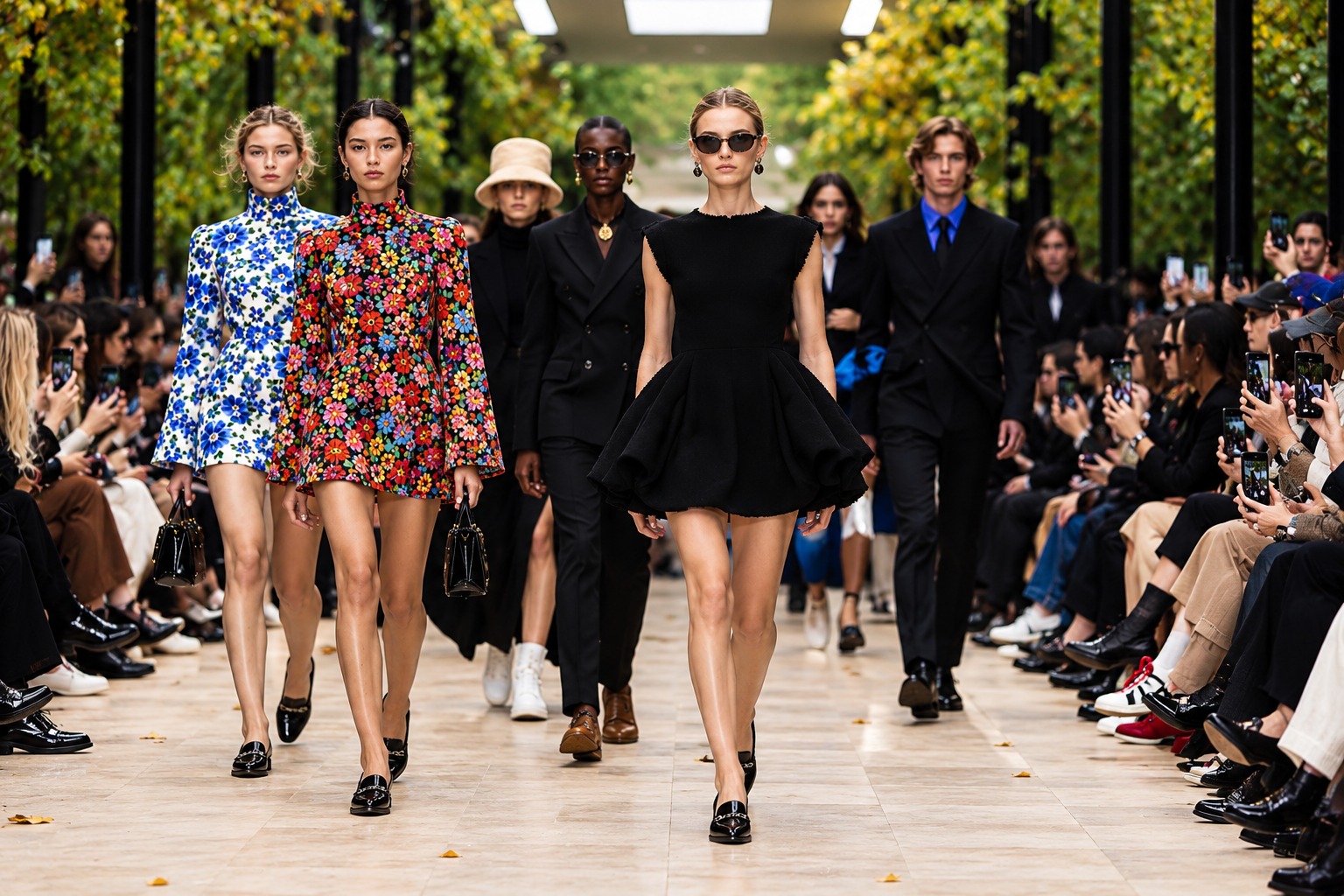
Paris Fashion Week's Spring 2027 season has two major comebacks worth watching closely: Maison Margiela and Valentino are both back on the official calendar after sitting out or stepping outside it. The comebacks themselves are notable. What each house is doing upon returning is the stronger signal.
Maison Margiela has already shown its SS27 collection on September 29. Valentino's return happens October 4. Taken together with a mass-market collaboration that launched today, this season is shaping up as a real case study in how commercial priorities are becoming more visible even in some of luxury fashion's most conceptual corners.
Why Maison Margiela Left Paris, and Why It's Back
Maison Margiela sat out Paris Fashion Week last season entirely, choosing instead to show in Shanghai as part of a broader series of exhibitions and installations across China. For a house built on a conceptual, avant-garde reputation, skipping fashion's most prestigious calendar was a notable departure.
The return comes alongside a significant creative decision. Glenn Martens, who has served as Maison Margiela's creative director since January 2025, stepped down from his parallel role at Diesel specifically to concentrate fully on Margiela. His final Diesel show took place in Milan on September 22. One week later, he presented Maison Margiela's Spring 2027 ready-to-wear collection in Paris, titled "Hard and Soft."
What Margiela's Return Actually Signals
The September 29 show leaned noticeably more commercial than Martens' earlier, more experimental work for the house. Coverage described the collection as built around a single, repeated construction element, a corset panel, fused with tailoring and draping across a coed lineup. Vogue specifically called it a "clearly commercial proposition," noting Martens discussing an intent to reach a broader customer base rather than designing purely for spectacle. The overall impression was fewer couture-level gestures and more pieces with a clear, direct path to the sales floor.
That shift lines up with real performance data, and the context around it makes the signal stronger. Maison Margiela grew 8.4% in 2025, the strongest performance among all of OTB Group's brands for that fiscal year, according to OTB's own full-year results. That growth stands out even more given that OTB's overall group sales declined in 2025. In other words, Margiela wasn't simply growing alongside a rising tide. It was the one bright spot in a group otherwise facing pressure, which gives Martens' pivot toward commercial clarity real business weight behind it, not just stylistic justification.
For brands watching this as a signal, the practical read is about merchandising philosophy as much as aesthetics. A repeated, recognizable construction element, like the corset panel anchoring this collection, functions differently than one-off, couture-level showpieces. It's the kind of design choice that translates more easily into a cohesive retail assortment: multiple pieces built around one signature detail, rather than a collection of standalone statement looks that are harder to merchandise as a group. That's a meaningfully different approach for a house previously known for deconstruction over cohesion.
Why Valentino's Return Adds to the Signal
Valentino's path back to Paris follows a similar arc. The house stepped outside the Paris calendar for its Fall 2026 show, staging it instead in Rome on March 12, a deliberate homage from creative director Alessandro Michele to the city tied to both his own history and the late Valentino Garavani's legacy. At the time, the house described the Rome detour as exceptional and temporary, confirming its intent to return to Paris for the following show.
That return is scheduled for October 4. As of this writing, the collection itself hasn't been shown yet, so there's no product detail to evaluate the way there is with Margiela. What's notable right now is the pattern: another major house stepping away from Paris for a symbolic, heritage-focused moment, then recommitting to the calendar's center stage for its next outing. Whether Michele's October 4 collection leans as commercial as Margiela's remains to be seen, but the scheduling pattern itself echoes Margiela's story closely enough to be worth tracking together.
The Zara x John Galliano Factor
A third data point arrived today, and it's arguably the most directly relevant one for US retail readers. John Galliano's first collection for Zara, called Re{form}, launched October 1, priced from roughly $30 to $1,000 and available globally online.
The significance here isn't just a celebrity designer collaboration. Galliano, who left Maison Margiela in December 2024 after a decade-long tenure, is applying couture-level technique, deconstructing and reconstructing archived Zara pieces using methods drawn from his haute couture background, to a genuinely mass-market price point. That's a direct, concrete example of high-concept fashion technique moving toward accessibility, happening in the exact same week as two major Paris houses are doing something similar at the runway level.
What This Means for US Brands and Retailers
None of these three stories alone would be a major trend signal. A designer consolidating focus, a house returning to a calendar, and one retail collaboration are all, on their own, fairly routine fashion industry news.
Together, they point toward something worth watching: several distinct parts of the fashion industry, from high luxury to fast fashion, moving toward more commercially legible, wearable output within the same narrow window. Luxury runway themes have always influenced what eventually shows up in mainstream retail, through silhouettes, materials, and styling choices that filter down over subsequent seasons. This season's pattern suggests that the filtering process may be happening with less of a time lag than usual, given how directly Galliano's couture techniques are already showing up at Zara's price point right now, not years later.
For US brands and retailers, the practical takeaway isn't to copy any single piece from these collections. It's worth looking at a few specific areas when planning upcoming assortments. Repeated, signature construction details, like Margiela's corset panel, tend to be easier to build a cohesive product line around than one-off statement pieces, which matters for how a design team translates a runway idea into multiple sellable SKUs. Materials and techniques once reserved for couture, like the archive deconstruction methods Galliano used at Zara, are also proving viable at accessible price points faster than in past cycles, which may be worth factoring into how aggressively a brand pursues similar crossover techniques. And the business performance data behind Margiela's shift is a reminder that commercial clarity and creative distinctiveness aren't necessarily in tension. The brand grew fastest in its group precisely while becoming more wearable, not despite it.
Is This a One-Season Story or a Bigger Shift
It's worth being honest about what this evidence does and doesn't prove. Two calendar returns and one retail collaboration, even a well-timed one, aren't by themselves a confirmed industry-wide trend.
What makes this worth tracking rather than dismissing as routine fashion week news is the combination: a creative director narrowing his focus specifically to produce more commercial work, a house posting its strongest growth figures while doing so against a backdrop of group-wide decline, a second major house following a similar away-and-back pattern, and a mass-market collaboration applying couture technique at accessible prices, all within roughly the same two-week window. That combination is more convincing than any single data point alone, though it will take another season or two of comparable signal to confirm whether this is a genuine multi-season shift or simply how this particular fashion month happened to line up.
Final Word
Valentino and Maison Margiela's Paris comebacks aren't interesting because the houses returned. They're interesting because of what each is doing, or is positioned to do, once back on the calendar's biggest stage, paired with a mass-market collaboration applying the same underlying instinct toward accessibility.
Tracking signals like this, across runway data, business performance, and retail collaborations at once, is exactly the kind of work TrendPulse AI is built for. Want a clearer, data-backed read on which industry shifts are worth building your next season around? Get in touch to see what Trendalytics' forecasting can show you.
FAQs
Why did Maison Margiela return to Paris Fashion Week?
Maison Margiela skipped Paris last season to show in Shanghai. It returned for Spring 2027 on September 29, alongside creative director Glenn Martens stepping down from Diesel to focus solely on the house.
Is Valentino's Paris Fashion Week comeback collection commercial?
Valentino's Spring 2027 Paris show is scheduled for October 4, and the collection hasn't been shown yet, so its direction isn't confirmed. Its previous show took place in Rome in March 2026 as a one-season departure from Paris.
How much did Maison Margiela grow in 2025?
Maison Margiela grew 8.4% in 2025, the strongest performance among OTB Group's brands that year, even as OTB's overall group sales declined.
What is the John Galliano x Zara collection?
Re{form} is a two-year creative partnership between John Galliano and Zara, launched October 1, 2026, with prices ranging from roughly $30 to $1,000.
Why did Glenn Martens leave Diesel?
Martens left Diesel after his Spring 2027 show in Milan to concentrate fully on his role as creative director of Maison Margiela, which he has held since January 2025.
Does a Paris Fashion Week comeback always signal a bigger industry trend?
Not on its own. A single comeback is routine fashion news. It becomes a meaningful signal when paired with other evidence, like business performance data or a pattern repeated across multiple houses in the same season.
What does this mean for US fashion retailers?
The gap between high-concept runway ideas and retail-ready product may be narrowing this season, which is worth factoring into merchandising decisions, like building assortments around signature construction details rather than one-off statement pieces.
Get ahead and stay
ahead with AI-powered trend forecasting.
Request a demo. Our AI tools are unmatched in the marketplace for predictive data and trend forecasting.