
Why Generic AI Can’t Predict the Next Big Trend?
.webp)

The Critical Data Gap Between Generic AI (such as ChatGPT) and Trendalytics AI
In the current retail landscape, AI is often marketed as a know-all oracle, causing many fashion and beauty executives to ask: "Why do I need a specialized platform like Trendalytics if I have a subscription to ChatGPT?" The answer lies in the distinction between information retrieval and predictive intelligence. While AI agents are excellent at combing through thousands of existing articles and summarizing them, saving hours of work in the process, they lack the foundational data required to forecast the future of retail that would deliver real commercial value.
The "Garbage In, Garbage Out" Problem
The effectiveness of any AI is strictly limited by the quality and depth of its underlying data. If the underlying data is not sound, then the AI summary is going to be an equal quality revision of the questionable input. General-purpose AI models like ChatGPT function as sophisticated search engines; they sift through and aggregate the entire internet of what has already been written, and create credible-sounding research summaries that would have taken a human weeks to accumulate and write. The narrative sounds correct and the conclusions seem intelligent, however, when you dive deeper, you start to see the underlying issues.
Issue #1: Sources from Generic AI are questionably credible
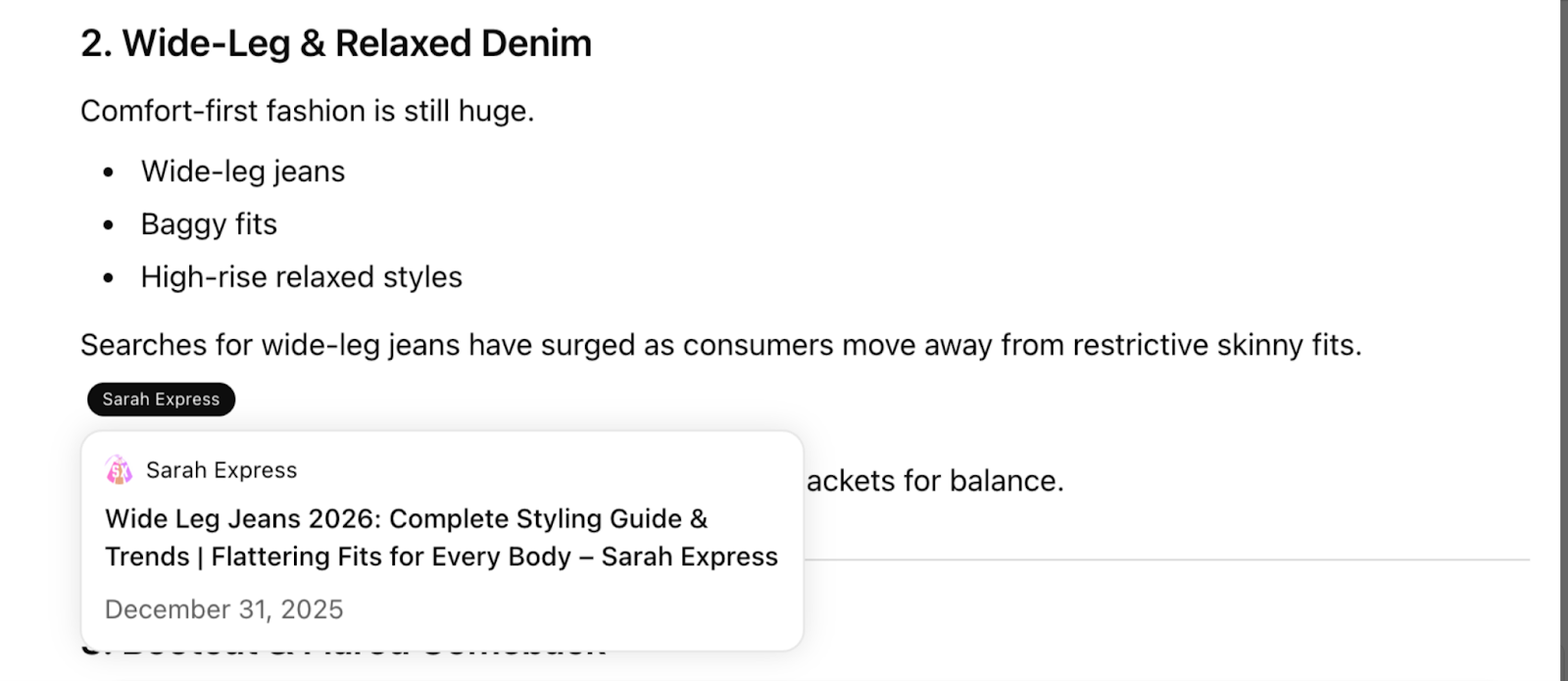
Generic AI: When we asked a generic AI tool “What are the top trends in denim?” it offered an example using “Sarah Express” as a source. Since most industry experts don’t know who Sarah Express is, her information source, or her typical audience, one cannot know if this trend is truly relevant.
Trendalytics AI: With Trendalytics, we’re selective with our sources, utilizing our millions of data points and internal content as well as hand-selected, credible industry sources to ensure that our recommendations are insightful, accurate, and of industry-standard quality.
Issue #2: Sources used by Generic AI are outdated
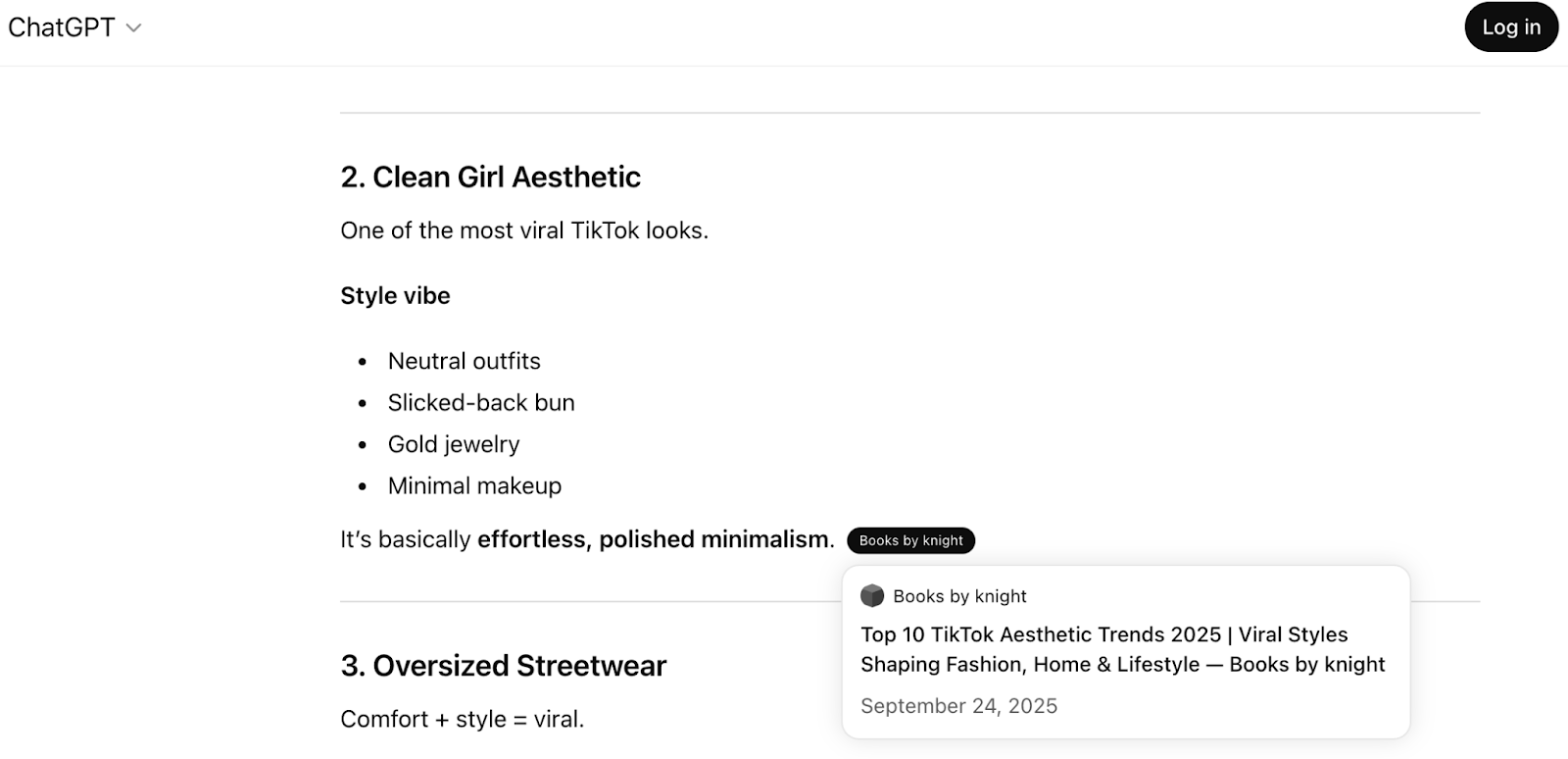
Generic AI: When asking a generic AI in March of 2026, what are the top fashion trends trending on TikTok, the second most popular trend was pulled from an article written in September of 2026, six months prior.
Trendalytics AI: At Trendalytics, we update our social data weekly across TikTok, Instagram and YouTube to be sure that our clients are getting the most relevant data as soon as it is available and can react in nearly real time.
Issue #3: Generic AI “data” is inconsistent and unable to be compared across trends
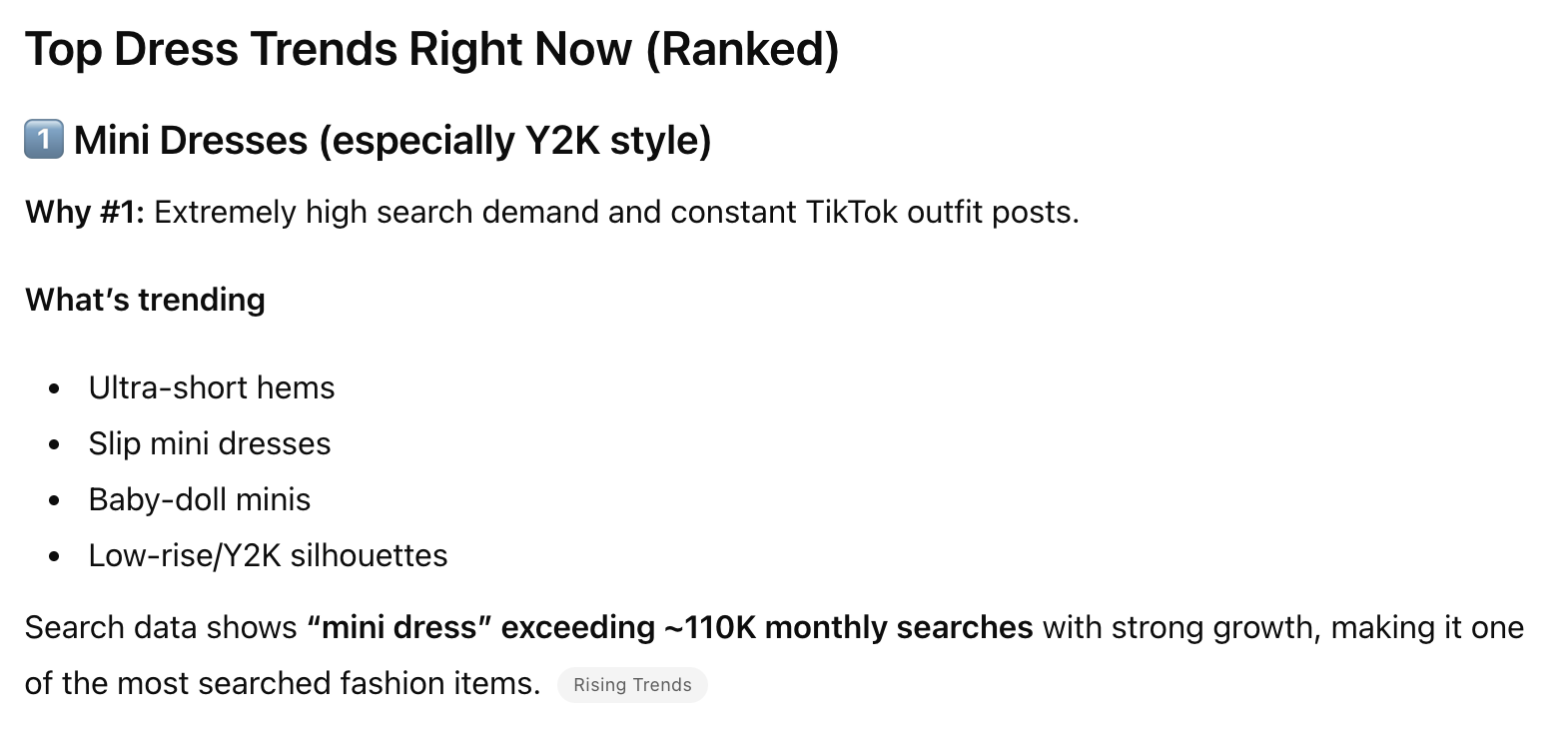
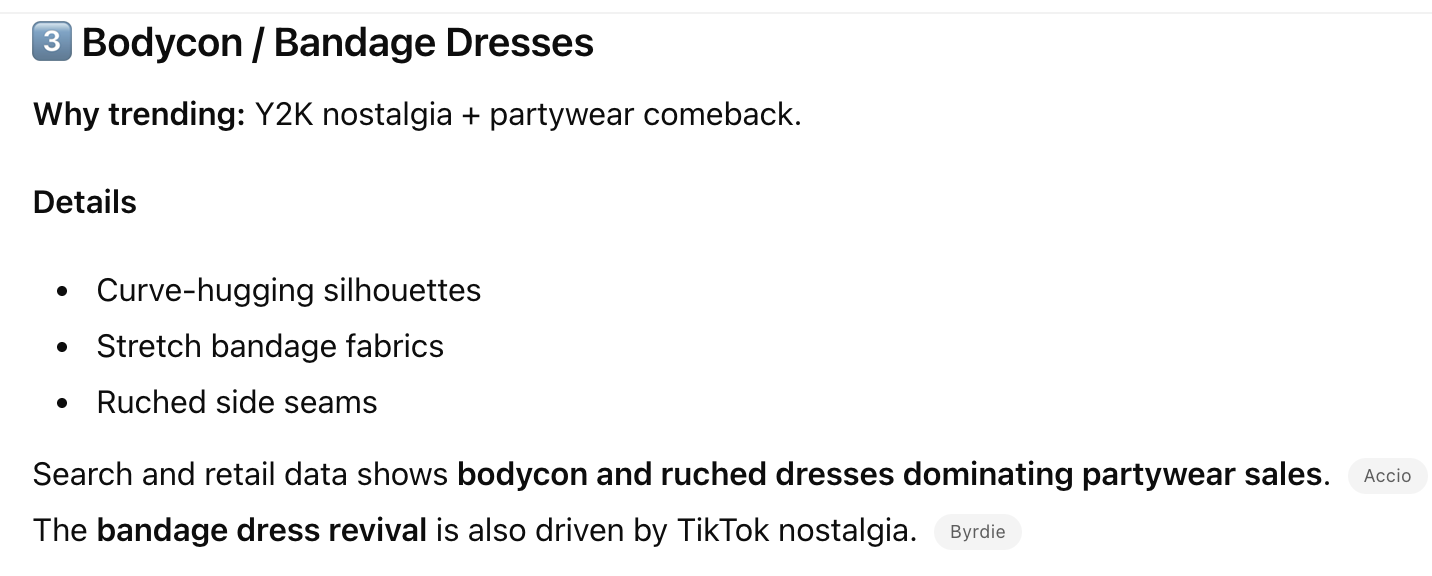
Generic AI: When asking a Generic AI to use Google and TikTok data to rank the top fashion trends in data, the ranking output cited almost no data. For one trend, Google search volume was cited without giving any data around increasing or decreasing volume, and did not cite any TikTok data. For all of the other trends, no data across Google or TikTok was cited at all with the comment that “search and retail data” was used.
Trendalytics AI: At Trendalytics, we offer volume and velocity data for Google search, TikTok, Instagram and YouTube for thousands of the most relevant trends.
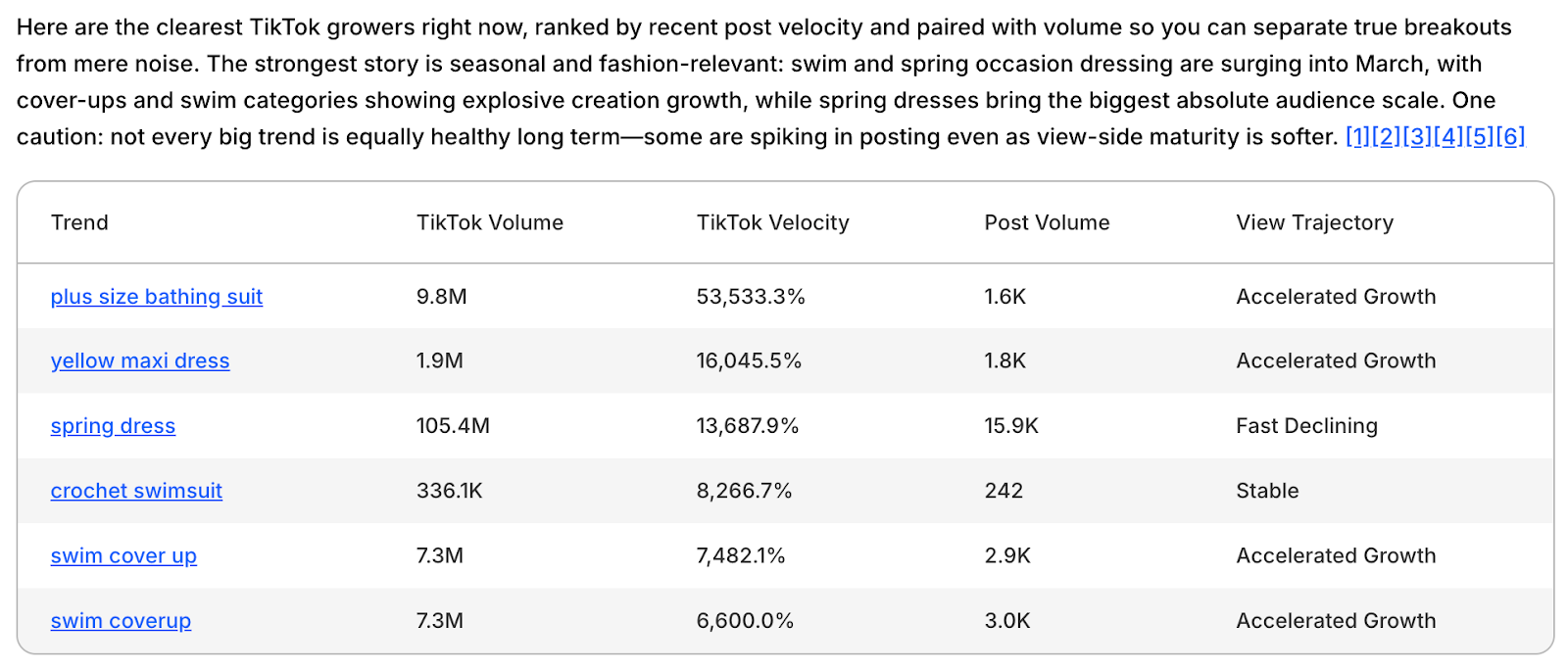
Trendalytics AI Output: What are the fastest growing apparel trends on TikTok?
Using Generic AI tools to get the most relevant trends often leaves the user feeling less confident about the trends than when they started their search. The data sources often lack credibility, they're often outdated and often impossible to compare data across multiple trends. The insufficient answer, void of data, makes it very difficult to predict what trends will be relevant in the future and does not provide any insight on the size of the bet a buyer or planner should be making.
Issue #4: Generic AI Can’t Intelligently Forecast
At Trendalytics, our advantage lies in the marriage of deep historical data with proprietary forecasting models. Generic AI lacks the specialized data needed to build a forecast. Additionally, Generic AI lacks the nuanced logic required to select the right statistical models, whereas we have rigorously back-tested our statistical models against years of social and search trends. This allows us to predict future performance with a level of precision that generic AI simply cannot replicate.
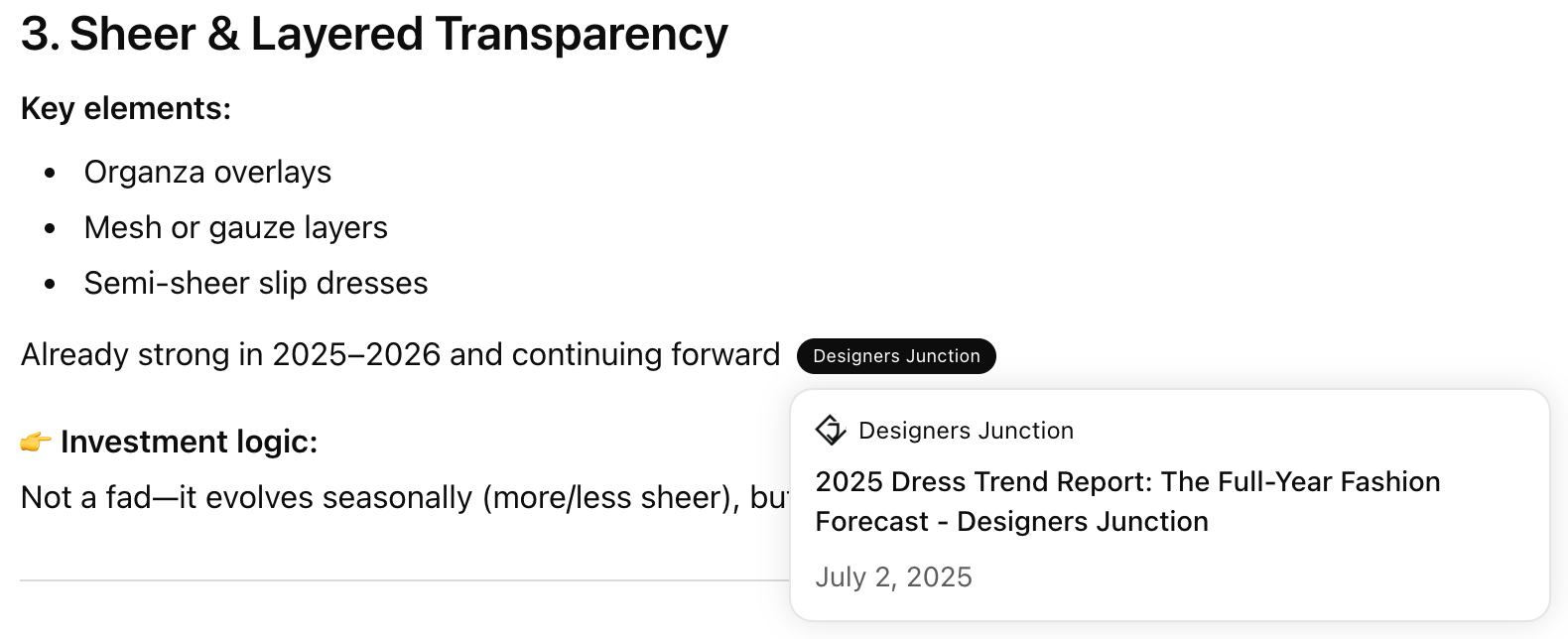
Generic AI: We asked a generic AI tool “Which dress trends are forecasted to be a safe investment bet in summer of 2027?”. The answer fell into all of the traps previously mentioned: used questionably credible sources (Is Designer’s Junction an expert in fashion?), lacked data-backed support, the source was outdated (question asked in March 2026 and source was from July 2025) and there was no way to compare the trend recommendations against each other.
Trendalytics AI: With Trendalytics, our data scientists have used years of back-tested, quantitative trend data across multiple search and social media sources to make predictions for each trend on our platform. Users are able to read current and predicted data to compare across trends.
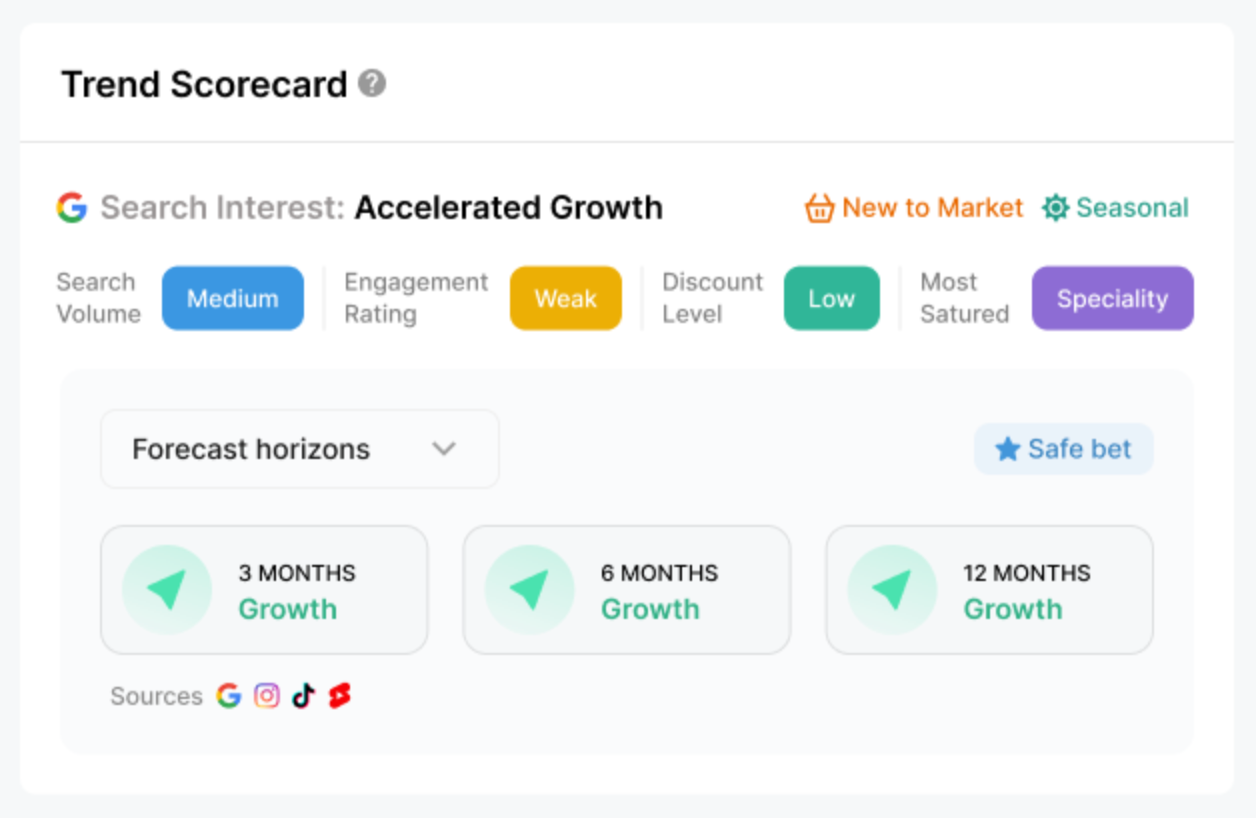
Trendalytics Forecast
The Missing Dimensions: Volume and Velocity
Predictive modeling requires more than just knowing a trend exists; it requires knowing its dimension. Investing millions into a style based on a fast growing TikTok trend is a massive risk if that trend lacks sufficient volume or critical mass.
Trendalytics tracks hundreds of millions of data points across Google Search, TikTok, Instagram and YouTube to provide:
- Volume: The size of the trend to indicate the level of adoption.
- Velocity: How fast the trend is gaining momentum.
- Lifecycle Positioning: Identifying exactly where a trend sits on the curve—from innovator to laggard.
Without these metrics, general AI cannot tell you how a trend will perform 12–18 months out. It can tell you what happened yesterday or now, but it cannot protect your inventory dollars for next year.
The Value of Predictive Intelligence
The difference between an AI tool like ChatGPT and Trendalytics is proprietary, structured data. Without this data, LLMs are unable to model the future. They are excellent at summarizing the past, but they lack the specialized architecture to build the future of retail. The true value of Trendalytics isn't just in "having data"—it’s in providing the high-resolution visibility required to transition from basic search to true AI-driven commerce.
To power that level of automation, "good enough" data isn't sufficient. General AI models provide a flat, two-dimensional view of the market. Trendalytics provides the mid-term visibility (12–18 months out) that allows retailers to actually have the right items in stock at the right time. Their structured data allows brands and retailers to compare the same metrics across thousands of trends versus LLMs that typically have disparate metrics for a select number of trends.
The Risks & Consequences of Generic AI
The real danger of relying on generic AI for trend forecasting is that you are gambling with your bottom line. In the best case scenario, you receive insufficient information that leaves you guessing. In the worst case scenario, the data is just plain wrong. These hallucinations and outdated "vibe checks" can trigger disastrous business decisions that cost retailers hundreds of thousands of dollars in lost profits.
When you commit your open-to-buy budget to a trend that has already peaked or never truly existed, you are left with mountains of dead inventory that must be cleared through aggressive markdowns or costly disposals. Beyond the immediate financial bleed, being visibly off-trend or behind the curve inflicts lasting damage on your brand reputation. Once your customers perceive you as out of touch, the loss of trust and brand equity can be far more expensive to repair than any single season of bad inventory.
Conclusion: Accuracy Over Aggregation
For retailers looking to make high-stakes inventory decisions, the "not far off" answers provided by general AI are not enough. Meaningful commercial change requires a level of accuracy that only comes from deep, structured, and timely data sets. LLMs like ChatGPT can summarize the conversation, but market intelligence tools like Trendalytics predict the commerce.
Relying on generic AI is more than a missed opportunity; it is a financial liability. Guesses masquerading as data lead to "garbage in, garbage out" decisions that trigger high markdowns, wasted inventory, and a brand identity that feels out of touch. While general models act as historians—sifting through outdated articles and qualitative "vibe checks"—Trendalytics provides the high-resolution visibility necessary to map the next 12-18 months of retail. In an industry where timing is everything, settling for a summary of the past can cost millions in the future.
Comparison: Information vs. Dimension
Get ahead and stay
ahead with AI-powered trend forecasting.
Request a demo. Our AI tools are unmatched in the marketplace for predictive data and trend forecasting.