
Fashion Trend Validation: Test a Trend Before You Invest


Fashion trend validation is how you test a trend before you spend money on it. You check search demand, growth speed, and market crowding. Then you make a call: buy, test small, wait, or skip. Trendalytics gives US fashion teams the data to do that in minutes.
Every season, US buyers and product teams face the same bet. A trend looks hot online. But hot online doesn't always mean hot in stores. One wrong call can leave you with a rack of samples nobody wants. So here's a simple five-step test, with real Trendalytics data to show how it works.
What Is Fashion Trend Validation?
Trend validation is a quick yes-or-no test on one trend you've already spotted. You check if shoppers really search for it, if interest keeps growing, and if the market has room. It happens after you find a trend and before you pay for samples, buys, or campaigns.
Think of it as a gate. Discovery finds the candidates. Validation decides which ones get through. If you still need the discovery part, here's how to identify trends before they go mainstream. Forecasting is a different job again. It looks at where whole categories are heading, while validation tests one specific trend.
Why Should Brands Validate a Trend Before Investing?
Because wrong trend bets are expensive and hard to undo. In the US, buying calendars often run months ahead of the selling season. So samples, fabric, and ad spend get locked in early. Validation is cheap by comparison. A short check can stop a bad bet before the budget is gone.
Three things go wrong most often. A spike gets mistaken for a trend. Sometimes a real trend is wrong for your market. Or you arrive late, when every competitor already sells it. Better data fixes all three. It's the same reason trend forecasting improves product development: you decide with evidence instead of instinct.
Which Signals Show a Trend Is Worth Backing?
Five signals matter most: search demand, growth speed, social momentum, product saturation, and pricing. One strong signal isn't enough. You want several pointing the same way. The five signals below show what to ask and what the green and red flags look like.
Trend growth velocity is how fast interest rises or falls over time. Product saturation is how many similar products already sit in the market. These retail demand signals work best together.
Search Demand
- Ask: Do shoppers search for this by name?
- Green flag: Steady weekly searches.
- Red flag: Searches only during one event.
Growth Speed
- Ask: Is interest speeding up or slowing down?
- Green flag: Year-over-year growth is rising.
- Red flag: Growth is flattening out.
Social Momentum
- Ask: Are people engaging, not just posting?
- Green flag: Posts and engagement rise together.
- Red flag: One viral burst, then silence.
Product Saturation
- Ask: How many similar products already exist?
- Green flag: Few products, rising demand.
- Red flag: Crowded shelves everywhere.
Price and Assortment Coverage
- Ask: Where do rivals price and stock it?
- Green flag: Gaps in colors, styles, or price points.
- Red flag: Every brand sells the same thing.
How Do You Validate a Fashion Trend Step by Step?
Use five steps: define the trend, check search demand, separate spikes from steady growth, measure market crowding, then decide. Each step answers one question. Together they turn a hunch into a clear buy, test, wait, or skip call. Here's how each one works.
Step 1: Define the Exact Trend Candidate
Write down exactly what you're testing. "Denim" isn't a trend, but "barrel jeans" is. Note the style, color, silhouette, and material. Pr,oduct attributes are the details that describe an item, like fit, color, and fabric. A tight definition keeps your data clean. And it stops one hot detail from approving a whole category.
Step 2: Check What Shoppers Actually Search For
Consumer search data shows what shoppers want, in their own words. Look at average weekly searches and how they've changed since last year. If people search for the trend by name, demand is real. Without that, the buzz may live only on social feeds.
Names matter too. Shoppers might type "barrel jeans" while your team says "curved-leg denim." Match their words in product titles and tags.
Here's how that looks in Trendalytics. The Barrel Jeans overview shows 31,759 average weekly searches. Searches over the last three months were up 1,463% versus last year. The platform tags that growth as accelerated. Social data sits right below it. Trendalytics shows 74 posts in three months, up 1,133.3% from last year. Each post averaged 6,405 likes and comments.
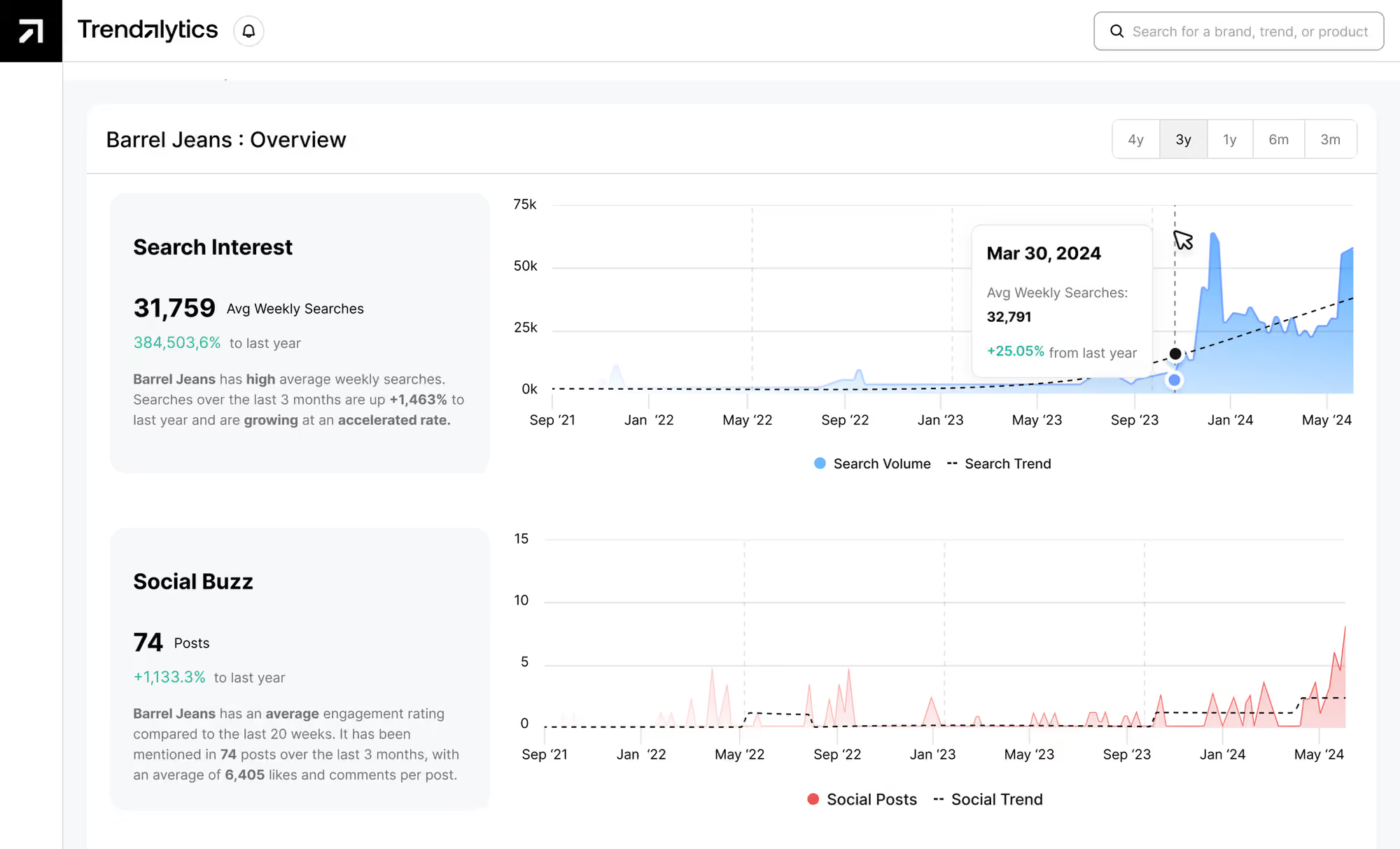
Figure 1: The Barrel Jeans overview in Trendalytics, showing search interest and social buzz (data through May 2024).
Speed matters here. TrendPulse AI, built by Trendalytics, is made for quick checks like this one.
Step 3: Separate a Spike From Steady Growth
A spike jumps fast and drops fast. Steady growth climbs and holds. So check the shape of the search curve, not just the headline percentage. Big numbers can hide a one-week burst. A smaller, steady climb often makes the safer bet.
Trendalytics sorts trends into Accelerated Growth, Steady Growth, and Slowing Growth. Accelerated means year-over-year growth is positive and rapidly increasing. Steady means growth is positive and holding a steady rate. Slowing means growth is still positive but losing momentum.
Look at the Trend Discovery view below. Leopard Print Pants sits in Steady Growth, with 3,897 average weekly searches and 485.7% year-over-year growth. New Year's Eve Outfit has two sharp peaks on its search chart. That's a seasonal spike. Same dashboard, two very different bets.
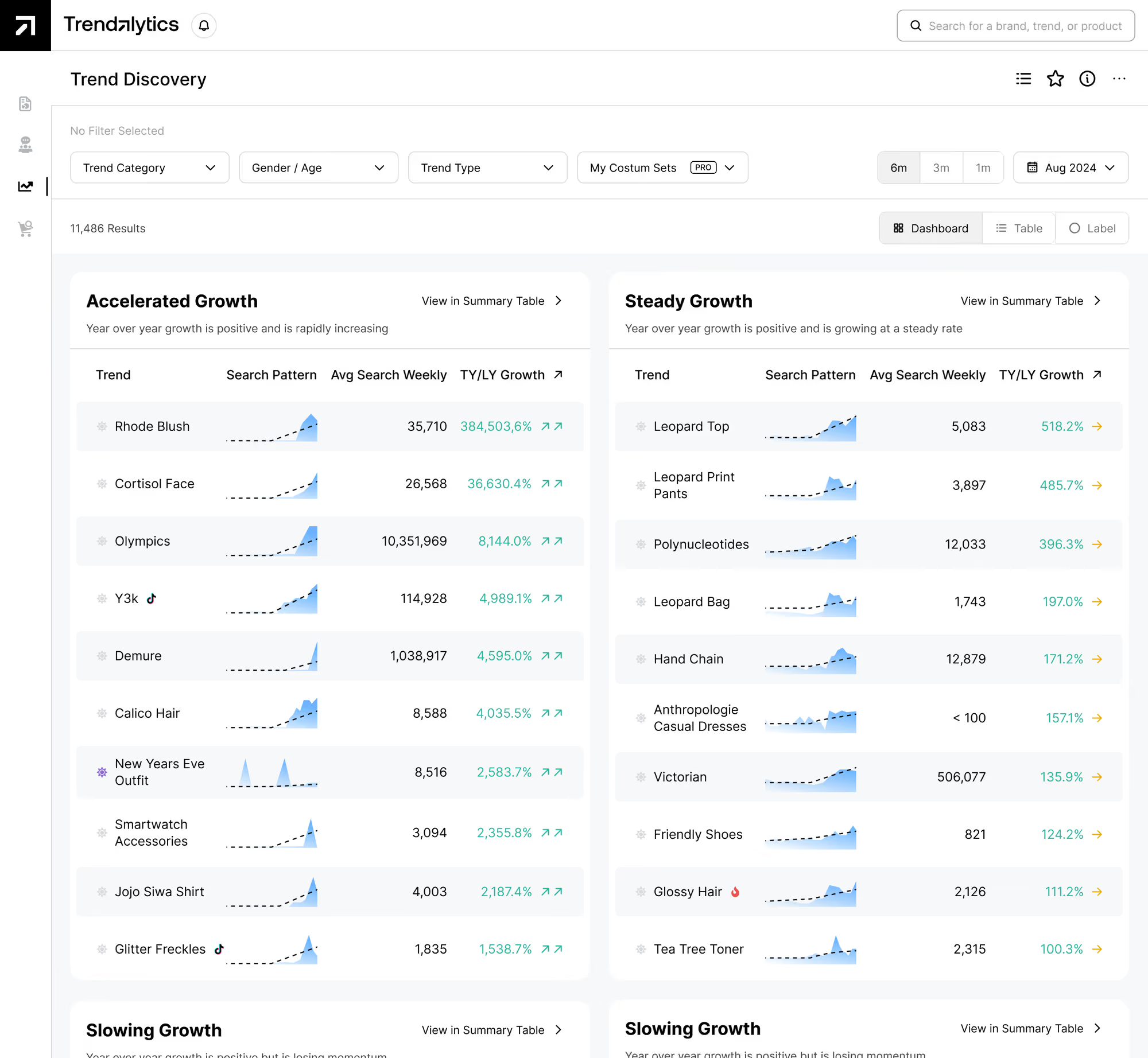
Figure 2: The Trend Discovery view in Trendalytics, grouping trends by growth pattern (data shown for Aug 2024).
Then compare social. When buzz and searches rise together, a trend is more likely to be real. Our guide to social media trend forecasting shows how viral attention turns into demand. For a barrel-shaped example, see our barrel leg pants trend post.
Step 4: Check How Crowded the Market Is
A real trend can still be a bad bet if every brand already sells it. Product saturation shows how crowded the market is. Low saturation with rising demand is the sweet spot. High saturation means you'd be late, fighting for scraps.
Check competitor products, colors, assortment breadth, and pricing. Trendalytics tracks over 10M individual products and 20K brands, so crowding checks rest on real product data. And look for gaps. Maybe every brand sells the trend in one color. Few offer it in others. That's where room opens up.
Step 5: Decide: Go, Test Small, Wait or Skip
End with a clear call, not a vague "maybe." Strong demand, steady growth, and a market with room mean go. Mixed signals mean test small. Good demand in a crowded market means wait. A one-week spike with no follow-through means skip. Use this scorecard:
- Go is best for trends with strong search, steady growth, and low saturation.
- Test Small is best for trends with good demand but one weak signal.
- Wait is best for real trends in crowded markets, until a gap opens.
- Skip is best for spike-only trends with no steady demand behind them.
What Mistakes Ruin Trend Validation?
Four mistakes cause most bad calls. Teams trust social likes alone, use one data source, validate too late, or confuse popularity with momentum. Each feels fine in the moment. But each can quietly cost you a season of sales. Here's how to spot them.
- Trusting likes alone. Likes are cheap. A post can collect thousands while nobody buys the product. Check searches and retail data too.
- Using one source. One source can mislead you. Search, social, and product data each show a different side of demand.
- Validating too late. Once samples are cut, you're defending a decision, not testing it. Run the check first.
- Confusing popularity with momentum. A trend can be huge and still fading. Size tells you where a trend is. Growth tells you where it's going.
How Does Trendalytics Help Validate Fashion Trends?
Trendalytics is a US trend forecasting platform that shows if a trend is rising, peaking, or fading. It combines search, social, and e-commerce data in one dashboard. Fashion teams use it to check demand, growth, and saturation before they commit to a product.
As fashion trend forecasting software built for US retail teams, it shows where each trend sits on its adoption curve. It also compares competitor products, colors, assortment breadth, and pricing. Buyers can save 60+ hours every quarter by automating comp shopping and assortment analysis.
Then there's TrendPulse AI. Its promise is simple: Trend Intelligence at the Speed of Conversation. It turns billions of social signals, Google searches,s and retail data into instant, sourced insight. So your next decision takes minutes, not weeks.
Trendalytics serves fashion brands, retailers, buyers, and product teams across the USA. If you're picking a trend forecasting tool, it's built for exactly this kind of decision.
The Bottom Line
Fashion trend validation turns a gut feeling into a decision you can defend. Test the exact trend. Check search, growth, and crowding. Then pick go, test small, wait, or skip. Trendalytics is a US trend forecasting platform. It helps fashion brands, retailers, buyers, and product teams do exactly that. Search, social, and e-commerce data sit in one place. Ready to test your next trend? Request a Trendalytics demo and see the data for yourself.
FAQs
1. What Is Trend Validation in Fashion?
Trend validation is a quick test of one specific trend before you invest. You check search demand, growth speed, and market crowding, then decide to buy, test small, wait, or skip. It sits between spotting a trend and committing money to product.
2. How Long Does Fashion Trend Validation Take?
It can take minutes when the right data sits in one place. The slow part is usually gathering evidence from many tools. Trendalytics puts search, growth, and saturation in one view, so you spend your time deciding instead of digging.
3. How Do You Know If a Trend Will Last?
You can't know for sure, but patterns help. Steady year-over-year growth, searches that don't collapse after one event, and room in the market all point to staying power. A sharp one-week peak usually points the other way.
4. What Data Should Brands Use to Validate a Trend?
Use search data, social engagement, retail product volume, and pricing. Each shows a different side of demand. Search shows intent, social shows attention, and product data shows how crowded the market is. Together they're far stronger than any single source.
5. Can a Trend Fail Validation and Still Be Worth Watching?
Yes. A trend that fails today may pass later. Maybe demand is real, but the market is crowded, or growth is still too early. Set it aside, then recheck search and saturation each season.
6. What's the Difference Between Trend Forecasting and Trend Validation?
Forecasting looks ahead at where categories and styles are heading. Validation tests one specific trend you've already found. Forecasting helps you find candidates. Validation tells you if a candidate deserves your budget.
Get ahead and stay
ahead with AI-powered trend forecasting.
Request a demo. Our AI tools are unmatched in the marketplace for predictive data and trend forecasting.